
Money for Nothing
Profit is Unpaid Wages
Wealth is created by labor:
If nobody extracts ore from the ground, it can’t be processed.
If nobody processes the ore, there’s no metal to be shaped into parts.
If nobody shapes the metal into parts, there are no components for a car.
If nobody assembles the components into a car, there’s no car to sell.
If nobody sells the car, it just sits in the lot and erodes.
Rocks will never spontaneously self-arrange into a car.

Every step in this process creates value. The ore is worth more than the ground; the metal is worth more than the ore; the parts are worth more than the metal; the car is worth more than the parts. The labor applied to the materials at every step is what makes those materials more valuable.
We often refer to goods and services as different things but that distinction is artificial and serves only to obfuscate our collective understanding of labor. The value comes from the work done: you’re not paying for a bunch of patches of land that hold materials that could be made into a lawnmower—you’re paying for an assembled lawnmower. Just like you’re not paying a landscaper to own a lawnmower—you’re paying them to use a lawnmower. It’s all labor.
The aggregate income that an individual or group or business receives for the goods/services it renders is revenue. Excess revenue is profit—income minus expenses.
Every operation has costs—land, equipment, buildings (factories, warehouses, offices), electricity, water, likely computers and internet service and paper and pens, maybe spare parts and fuel and oil and robots… and certainly labor.
All of these costs are necessary, but without labor none of the others matter. You can rent an office and fill it floor to ceiling with equipment but it’s all useless if you don’t have anyone using that equipment to do whatever work needs to be done. Customers aren’t going to pay you to just Own Equipment.
In other words: no work, no revenue. Without labor, a business’s operation is solely expenditure with zero income.
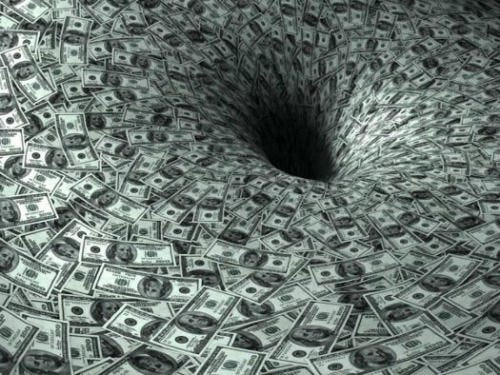
And yet labor is often treated as the most disposable and worthless of a business’s expenses. Long before any cuts to exorbitant executive bonuses and shareholder dividends, workers get laid off or have their hours slashed. They go years without raises, or sometimes even see their pay reduced. The minimum wage is presently worth less than it was worth fifty years ago.
Often these reductions to labor—layoffs, pay cuts, etc—come not as the result of a business’s losses but because their profits did not meet projections. Remember that profit is the amount of income left over after expenses have been accounted for—your business hasn’t suffered a loss if it’s still making profits. It seems shareholder returns are viewed as a more important and necessary portion of revenue than the labor that actually generated that revenue. “Profit” is really just a fancy way of saying “unpaid wages”, so in an ethically-mutilated way it makes sense that the owner class would consider wages unreaped profits.
Meanwhile we’re fed this narrative about the Almighty Risk: executives “deserve” to be paid 400 times more than the average employee because their decisions carry so much risk, and if they make a bad decision, it’s their career on the line.
Okay, cool—name me one single executive who has ever suffered serious financial and professional repercussions as the result of decisions they made that failed to work out. In reality, bad decisions made at the top only ever threaten other people’s jobs and livelihood. In fact, the executives responsible for the bad decisions that led to the 2010 housing crisis and recession still received their bonuses—at taxpayers’ expense! (Thanks, Obama!)
As far as investors’ “risk” is concerned, they diversify their holdings and hedge all their bets, and the wealthiest of them are so rich that even if they lost half of what they had they’d still be richer than entire countries. Even if Jeff Bezos “loses” $10,000,000,000—ten entire billion dollars—because of a bad day in the stock market, he still has ten times that amount left. He could lose 99% of his net worth and still be a billionaire. And the only way he’d lose enough to no longer be a billionaire would be if the entire economy experienced complete catastrophe. What “risk” could he possibly have?
You’re undeniably taking a far greater risk working at a business (in a non-executive capacity) than you are starting or investing in a business or working as an executive. Many benefits rely on accrued tenure. Pay, number of vacation days, retirement benefits, bonuses—all of this is often tied to how long you’ve been working at a particular company. And it could disappear in an instant, often because the business only made $30,000,000 in profit rather than the expected $40,000,000, forcing you to start all over again at the bottom rung of another ladder, with no golden parachute to float you there.
Hell, I know people who’ve been laid off the month before bonuses were due to be paid out, or been forced out a year or two before retirement benefits would’ve kicked in or escalated. These were hardworking people who got massively screwed out of compensation so that executives and investors could still get the profits they felt entitled to—and still receive despite the fact that we’re told they’re the ones holding all the risks of businesses failing.
As far as small businesses go, 80% survive the first year and 50% survive the fifth year, which aren’t amazing numbers but the odds are still 50/50 for succeeding through an entire half a decade. Plus, keep in mind that those figures include “businesses” that are ridiculous vanity projects that likely should never have been started in the first place. Sure there’s undeniably more risk involved in this arena versus that of massive corporations, but the lede is kind of buried here: what this illustrates is that maybe we shouldn’t have a society wherein starting a small business and failing means risking personal financial ruin.
Something important to keep in mind as well here is that nearly all the owners of these small businesses are not the top 1%. Hell, many of them probably aren’t even the top 5%. But the extremely wealthy refer to them inclusively as though a mom-and-pop operation where owners pull in maybe $50,000 for themselves could ever possibly belong to the same class or category as an investor making $10,000,000 a year. And they’re certainly not referring to those small businesses that fail after five years, where the owners likely barely make more than they’re paying their employees, or are accruing debt. But that feigned inclusiveness by the powerful is a way to ally portions of the middle class with the extreme elites who are fucking us all over.
Ultimately, though, if you can’t afford to pay your employees enough to get by, then you don’t actually have a business—you have a bubble. And it’s a bubble kept aloft solely through the exploitation of workers. If your business model required you to not pay your employees enough to live, then you shouldn’t have even started a business in the first place.

So, all this Risk shit is irrefutably overblown and if anything only really applies to 50% of small businesses after 5 years, and even then what it actually illustrates is that we need social safety nets so that it’s possible to fail at starting a business without jeopardizing your solvency for the rest of your life.
And yet whenever you suggest reducing executive salary or investors’ returns in favor of providing workers a fairer share of the yield of their labor, conservatives cry foul. “What incentive will they have to take the risk of starting or investing in a business? Why would they take a high-risk, high-stress executive job if they’re only getting paid millions a year and not tens of millions? Why would you punish success?”
Strangely these same people usually also claim that workers should be satisfied to work jobs for poverty-level wages. I’ve never even once seen them lament that we’re punishing the workers who built all this wealth by denying them a fair share of it. Somehow “punishing success” only applies to the Owning Class and never the Working Class, who are expected to continue to build wealth for other people no matter what.
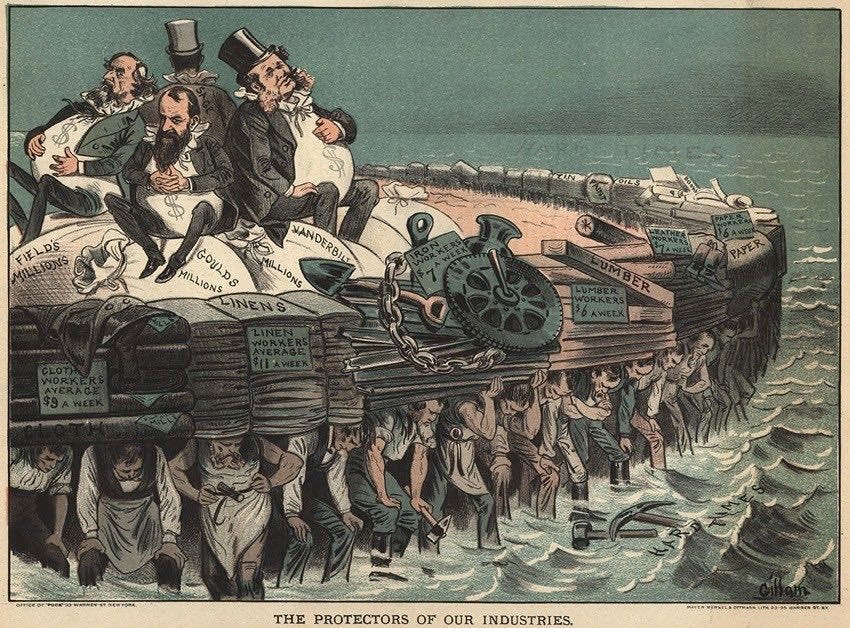
We’ve been made to forget what wealth is and how it’s made. We’re told that because some jobs don’t require a lot of skill and could be done by just about anyone, it means they’re not worth much—overlooking the fact that these jobs still need to Get Done in order for businesses to obtain revenue. And if these jobs truly “weren’t worth much” then they wouldn’t be generating vast fortunes for the people at the top.
They’ve tricked us by defining the value of labor not by its yield but by its requisite skill set, and the most gullible or thoughtless of us finds nothing wrong with that. But as technology makes all jobs easier and easier, eventually that same “anyone can do it” argument will apply to just about everything, and if we’re continuing to value labor not by its yield but by the rarity of skill involved, many of the people who sneeringly look down on McDonald’s fry cooks will soon find themselves wishing they’d stood in solidarity with the working class rather than fetishizing the owner class.
Look Upon My Works, Ye Mighty
Weapons-Grade - A near-future dystopia where war machines can think for themselves. When one of them suffers a sudden existential crisis, it sets off a chain of events that threatens the very survival of humanity.
Seinfelt - Anthology of surreal/existential horror synopses and short stories set in the Seinfeld universe. Jerry loses all his teeth in the middle of a show. George wakes up one morning suddenly unable to feel hot water. Kramer finds a hair in his belly button that keeps getting longer the more he tries to pull it out. Elaine falls asleep at the salon and wakes up with live snakes for hair.
Co-authored with T. R. Appleton.
Waiting Room - A Twin Peaks-inspired iOS app that lets you record and reverse audio and video. Learn to speak phonetically backwards and record videos of yourself as though you're in the Black Lodge.
Retro Future - Hop in your dad's time machine—we're going to the future we should have had.
Greatest Show on Earth - But the circus isn't scheduled to be in town for another month… and it certainly isn't supposed to be set up in the middle of the graveyard.
Horror Music - A collection of horror-themed music I’ve made.
Video Game Streams - Do you appreciate video games as a form of entertainment but you don’t really feel like playing them yourself? Come check out my stream! I play all sorts of games while talking to a camera. Put it on while you’re falling asleep at night!
Thanks!
As always, thank you for reading.
If you've enjoyed this newsletter or have gotten anything out of it, please subscribe (if you haven't already) and tell your friends.
Until next time! Stay strong.